The recent pullback in gold, silver and mining equities has prompted questions over the outlook for the precious metals sector, which just months ago was hitting all-time highs. Yet, corrections are a normal feature of every bull market, shaking out speculative positioning, resetting sentiment and, most importantly, creating opportunities for long-term investors. Far from signalling the end of the bull market, we consider that recent weakness has set the stage for the next phase of the up-cycle, alongside other metals such as copper which have made strong recent gains.
Following gold and silver’s rapid moves to USD 5500/oz and USD 120/oz respectively during February, profit taking and a hawkish shift for US interest rates have driven a sharp pullback. Yet there has been no change to the structural case for gold, which remains more compelling than it has been for decades. The world is grappling with geopolitical fragmentation, record government debt, unsustainable fiscal deficits, and monetary policy direction which imply financial repression over fiscal restraint. These forces are unlikely to disappear any time soon, suggesting the bull market for the precious metals sector may have significantly further to run. For investors, the recent pullback represents an opportunity to add exposure to gold and silver miners, where valuations remain attractive, despite strong margins and profitability, as well as attractive buyback and returns programmes.
A healthy correction in a secular precious metals bull market –
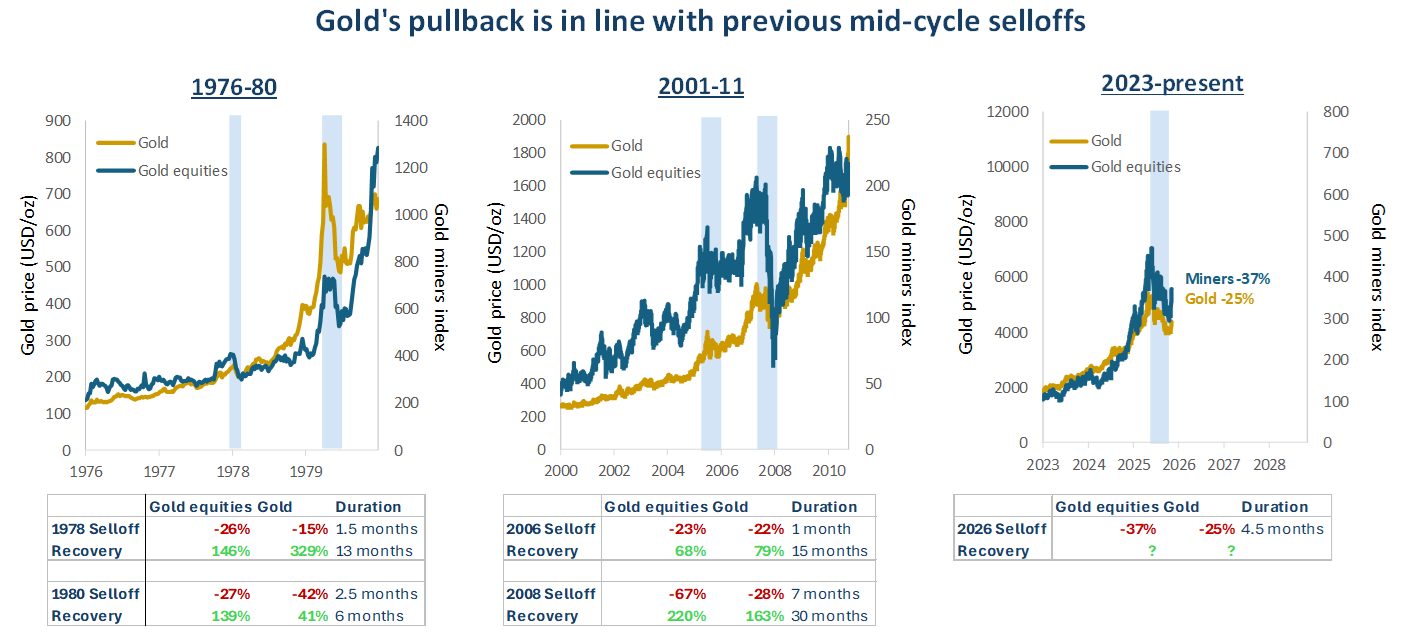
Sharp pullbacks are normal during gold sector bull markets, with corrections of 20–30% often preceding a strong recovery for gold and precious metals miners.
Demand drivers for gold remain strong and broad based, with recent central bank buying offsetting gold ETF selling. Macroeconomic conditions remain supportive for precious metals.
Gold miners present an opportunity having sold off despite strong margins, cash generation and selective growth. Importantly the sector is maintaining capital discipline as precious metals prices rise.
Figure 1
Source: Bloomberg, Baker Steel internal. Data in USD, as at 11th August 2026.
Should precious metals investors buy the dip?
The past two years have seen momentum build in the precious metals sector as record central bank buying, escalating geopolitical tensions, and rising investor demand combining to push prices steadily higher. In recent months, however, the market narrative has shifted as investors´ attention refocused on US rates. The appointment of Kevin Warsh as US Fed Chair, accompanied by a rise in oil prices amid the US-Iran war, caused markets to reassess the timing and direction of rate decisions. Treasury yields rose and the dollar strengthened, creating temporary headwinds for precious metals.
Since February’s highs, gold has dipped -25%, while precious metals miners have pulled back -37%[i]. As illustrated on the charts above, this retracement is consistent with mid-cycle pullbacks in the previous gold bull markets of the 2000s and 1970s, both in terms of magnitude and longevity. During these previous cycles, these pullbacks represented excellent buying opportunities for investors, particularly for precious metals miners, which have historically tended to outperform during the later stages of a bull market. The question for investors is: will gold’s bull market resume?
There are many factors at play when assessing gold’s outlook. Rates and the US dollar play a significant role, alongside demand and supply dynamics and the macroeconomic outlook. At the time of writing, gold and precious metals miners are already reversing their recent decline, supported by investors buying the dip, as yields ease amid more doveish rate expectations and the prospect of a steady Federal Reserve stance.
Strong fundamentals – A broad demand base for gold and macroeconomic tailwinds
Perhaps the strongest argument for continued optimism lies in gold’s robust underlying demand strength and tight supply. Unlike previous cycles, today’s bull market is not being driven by a single source of buying. Instead, demand is broad-based across central banks, institutional investors, retail investors and jewellery consumers, with new investors including crypto firms and Chinese institutions providing additional sources of demand.
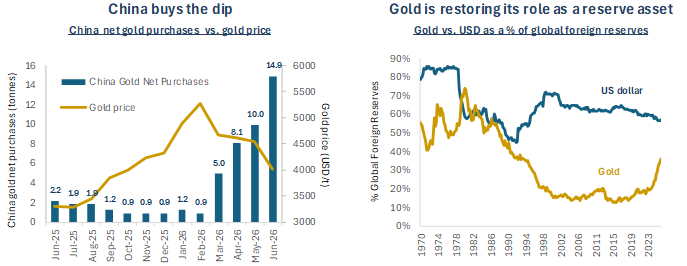
Central banks have emerged as perhaps the most important marginal buyers of gold, with purchases of around 1,000 tonnes annually since 2022[ii]. This trend reflects the restoration of gold’s historic role as a reserve asset, which carries no counterparty risk and cannot be sanctioned. Central bank buying also represents the long-term trend of de-dollarisation as emerging market central banks, including China, India and several Middle Eastern nations, continue to diversify reserves away from the US dollar[iii].
Recent buying highlights that this trend is intact, with central banks purchasing 289 tonnes of gold in Q2 2026, the strongest second quarter on record, as the gold price dropped[iv]. Given ongoing geopolitical fragmentation and challenges to the long-term dominance of the dollar, there is little reason to expect this buying trend will reverse.
Figure 2
Source: World Gold Council, August Gold Reserves by Country. Bloomberg. Data at 30 June 2026.
Regarding investment demand, recent months have seen selling pressure for gold ETFs, particularly in North America, while bar and coin has held steady[v]. Following such strong investment demand in late-2025 and early-2026, a tempering of demand likely represents a return to more typical levels of buying. Importantly, many diversified portfolios remain structurally underweight precious metals and mining equities, after more than a decade in which technology stocks dominated. It is estimated that gold ETFs represent just 0.17% of US private investor portfolios[vi], while the total market capitalisation of the gold mining sector accounts for less than 1% of global equity markets[vii]. If we are in the early stages of even a modest reallocation towards real assets, notably gold, this trend could have a meaningful impact on prices given the relatively small size of the market.
Jewellery, still the largest source of annual gold demand, has seen volumes drop following the move upwards in precious metals price, yet has remained remarkably resilient. In dollar terms, spending on gold jewellery continues to rise year-on-year[viii].
Gold supply continues to face a tight outlook, as sizeable high-quality discoveries become increasingly rare. Despite a rise in exploration spending over the past decade, the number of world-class gold discoveries has continued to decline while ore grades have also fallen steadily[ix]. Supply is further constrained by the lengthening of permitting timelines, stricter environmental standards and geopolitical risks. Capital discipline among the major mining companies has also restricted production growth. As a result, the gold sector has had an inelastic supply response to higher demand, with gold mine supply having risen just 2% over the past year[x]. Unlike some commodities, significantly higher gold prices cannot quickly generate meaningful new production. This combination of robust demand and constrained supply provides powerful long-term support for bullion prices.
Macro demand drivers – Fiscal dominance ahead?
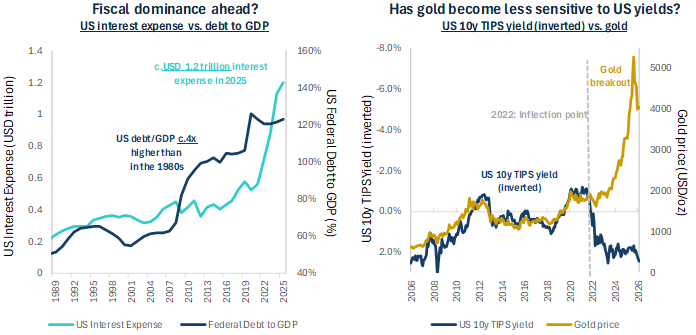
Given gold’s sensitivity to US rates and the dollar, an assessment of the outlook for gold is closely tied to macroeconomic conditions for the US. The deterioration of US finances in recent years presents a major potential driver for gold demand in the years ahead. The United States is running fiscal deficits rarely seen outside wartime or deep recessions, while federal debt continues to climb rapidly[xi]. Interest payments on government debt are now well over USD 1 trillion annually, having become one of the largest items in the federal budget[xii].
Figure 3
Source: Bloomberg, U.S. Government Accountability Office, Baker Steel internal. Data as at 31 July 2026.
Such levels of debt indicate a risk of fiscal dominance ahead, as monetary policy becomes constrained by the need to finance government debt. In such an environment, maintaining moderate or high real interest rates becomes increasingly difficult. Higher rates dramatically increase government borrowing costs, creating political and economic pressure for monetary policy to become more accommodative. History suggests governments facing excessive debt burdens rarely solve the problem through austerity. A more likely outcome is to maintain nominal interest rates below inflation, resulting in currency debasement and financial repression. This environment would be highly supportive for gold, as investors seek to hold real assets to protect their wealth and purchasing power.
As shown above, gold’s sensitivity to US real rates may have reduced somewhat since 2022, as new entrants to the market began to drive prices, yet the direction of monetary policy is still highly significant. Speculation of a hawkish shift by the Fed appears to now be priced in, while recent US intervention in the yen highlights that policymakers will continue to take action to prevent US Treasury yields rising too far.
After the sell-off, precious metals miners have rarely looked healthier
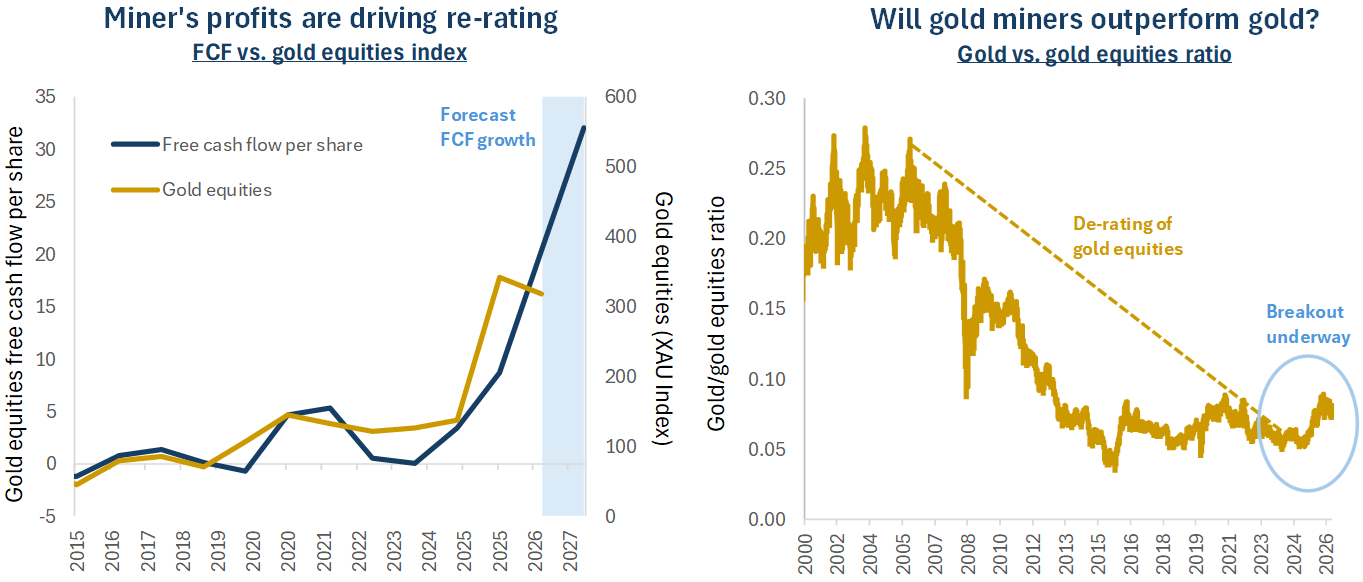
Even as gold and silver prices hit record highs earlier this year, precious metals mining equities continued to trade at valuations below their long-term averages[xiii]. The recent sell-off has made valuations even more attractive. In comparison to the last major commodity cycle in the 2000s, gold and silver producers are focused on generating free cash flow rather than simply growing production. Balance sheets across the industry are generally strong, leverage remains low and many companies are generating record cash flows at current gold prices.
The sector has started to re-rate, making strong gains last year as the bull market gained pace. We believe the genuine capital discipline being exercised is the key to further re-rating, as strong margins are maintained and shareholder returns continue to strengthen. As shown on the chart below, gold equities have started to outperform gold once again yet remain far below the last cyclical peak in terms of relative valuation.
Figure 4
Source: Bloomberg. Data at 31 July 2026. Data in USD. Estimated FCF data for 2026 and 2027.
But can miners keep their discipline during the next phase of the precious metals bull market? Currently, we see encouraging signs of discipline, such as capital expenditure being directed towards brownfield expansions, operational improvements and selective development opportunities. M&A activity has been largely constructive, with recent deals focused on improving asset quality and generating operational synergies. Importantly for investors, dividends and share buybacks have remained a core policy for many miners, representing a significant change from previous cycles which should support share price re-rating over time.
Despite these improvements, precious metals miners currently trade on just 4.7x EV/EBITDA, far below major equity sectors such as technology (15.2x), healthcare (14.5x) and industrials (14.7x), highlighting the value in the sector[xiv]
Mid-cap precious metals miners offer further upside potential, as do select junior miners for investors willing to accept the heightened volatility which can come with investing in this portion of the market. Many exploration and development companies continue to trade below the intrinsic value of their assets despite improving fundamentals. As gold prices remain elevated, financing conditions are improving, as investors seek exposure to new discoveries.
An opportunity for accumulation
Every bull market faces corrections, and the question for investors is whether the underlying investment thesis has changed. In the case of the precious metals sector, we consider it has become even stronger. Demand for gold from a broad range of investors remains robust, against a backdrop of expanding fiscal deficits and rising debt burdens. Real assets are poised to become increasingly valuable as policymakers face fiscal dominance and the public face the prospect of financial repression should nominal rates be held below inflation. Meanwhile mine supply remains constrained.
We consider that recent weakness in the precious metals sector looks less like the beginning of a bear market and more like a healthy reset within an ongoing secular uptrend. For disciplined investors taking a longer-term view, the recent pull back may offer an attractive opportunity to build positions across gold, silver and precious metals miners. Miners in particular offer a compelling opportunity at this point in the cycle, combining strong profitability with capital discipline and attractive shareholder returns. Furthermore, for active investment managers the mid-cap and junior portion of the market can offer the potential for significant upside as capital flows back into the development end of the market.
Gold’s rebound in recent days is a positive sign that the sector’s pullback is nearing completion. Bull markets rarely move in straight lines, and we consider the destination for precious metals miners may still be considerably higher.
[i] Bloomberg, data in USD terms, as at 7th August 2026.
Baker Steel Capital Managers LLP manages three award winning investment strategies, covering precious metals equities, speciality metals equities and diversified mining.
Baker Steel has a strong track record of outperformance relative to its peers and relative to passive investments in the metals and mining sector. BAKERSTEEL Precious Metals Fund is the 2025 winner of the GELD-Magazin Alternative Investment Award, and 2025 winner for the seventh year running of the Lipper Fund Awards while BAKERSTEEL Electrum Fund is the 2025 winner of the Euro Fund Awards Commodity Equities Performance over 10 years. The Baker Steel Resources Trust has also been named Investment Company of the Year 2021, 2020, 2019, Natural Resources, by Investment Week.
Fund Managers Mark Burridge and David Baker have been awarded two Sauren Gold Medals for 2021 and were awarded Fund Manager of the Year at the 2019 Mines & Money Awards.
Important
Please Note: This document is a financial promotion is issued by Baker Steel Capital Managers LLP (a limited liability partnership registered in England, No. OC301191 and authorised and regulated by the Financial Conduct Authority) for the information of a limited number of institutional investors (as defined in the Fund prospectus) on a confidential basis solely for the use of the person to whom it has been addressed. This document does not constitute or form part of any offer to issue or sell, or any solicitation of any offer to subscribe or purchase any shares or any other interests nor shall it or the fact of its distribution form the basis of, or be relied on in connection with, any contract therefor. Recipients of this document who intend to apply for shares or interests in Baker Steel’s funds are reminded that any such application may be made solely on the basis of the information and opinions contained in the relevant prospectus or other offering document relating thereto, which may be different from the information and opinions contained in this document. This report may not be reproduced or provided to any other person and any other person should not rely upon the contents. The distribution of this information does not constitute or form part of any offer to participate in any investment. This report does not purport to give investment advice in any way. Past performance should not be relied upon as an indication of future performance. Future performance may be materially worse than past performance and may cause substantial or total loss.