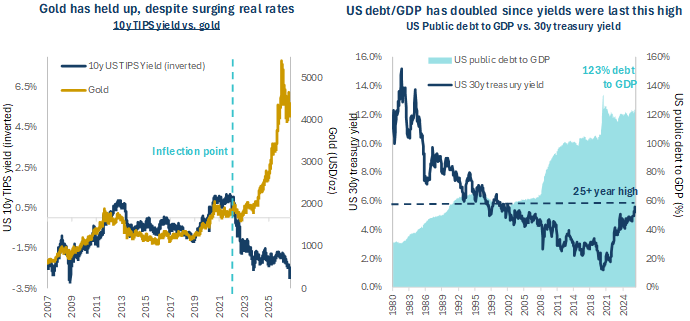
Yields are hitting multi-decade highs, reflecting rising concerns about government borrowing, inflation and fiscal credibility. Historically, higher yields have proven a headwind for precious metals, yet gold prices remain resilient, holding at around USD 4200/oz even as yields have risen sharply.
The traditional relationship between US real yields and gold has broken down. The structural forces of de-dollarisation and increased strategic holdings of physical gold across a wide range of investors are underpinning gold demand, while mounting concerns over the long-term sustainability of US government finances has set the stage for the next phase of the bull market for precious metals. These dynamics suggest that gold is increasingly becoming a hedge against the financial risks associated with an overindebted global financial system.
With this positive setup for gold, the recent sell-off in precious metals miners has created a compelling opportunity for investors to build positions in the sector. Precious metals miners currently offer strong margins, capital discipline and shareholder returns, yet remain undervalued and under-owned by generalist investors. The crisis also holds implications for the broader metals and mining sector, which tends to thrive as the US dollar comes under pressure.
The debt crisis sets the scene for gold’s next leg higher –
Gold’s resilience signals a new upcycle ahead – Higher yields are proving a mild headwind for gold, yet the prospect of government intervention, fiscal dominance and financial repression present significant catalysts.
Structural demand trends and macroeconomic tailwinds– Strong demand from fundamental buyers continues, while rising US financial risk presents a driver for investors to increase allocations to gold.
Substantial upside potential in miners – Recent consolidation is a chance to build
Figure 1
Sources: Bloomberg. Data at 9th October 2026.
Gold’s relationship with yields has fundamentally changed
For decades, the inverse relationship between gold and US real interest rates proved a reliable indicator of the strength of the precious metals sector. Higher real yields increased the opportunity cost of holding a non-yielding asset, typically weighing on gold prices. Conversely, falling real yields tended to provide a powerful tailwind. Yet since 2022, this relationship has broken down. In recent years, gold has demonstrated remarkable resilience despite a material rise of US borrowing costs. While rising yields continue to result in volatility for gold, the metal’s underlying strength highlights that investors are responding to a more fundamental shift in the global monetary landscape.
As shown on the chart above, 2022 proved an inflection point for both yields and gold. Sanctions on Russia and the “weaponisation” of the dollar following the invasion of Ukraine in 2022, including the freezing of c.USD 300 billion in Russian sovereign reserves[i] was a watershed moment for the international monetary system. For the first time in decades, central banks faced the reality that foreign exchange reserves, even those invested in highly liquid Western government securities, could become inaccessible for geopolitical reasons. The implications were particularly significant for emerging market central banks already seeking to reduce their exposure to the US, accelerating the de-dollarisation trend already underway.
These events have fundamentally altered gold’s role for policymakers, as it becomes increasingly valued for its independence from the dollar-based monetary system. Physical gold held domestically carries no counterparty risk and cannot be printed or frozen through another country’s banking system.
Alongside the official sector, the years since 2022 have seen a wide range of buyers in the gold sector, from retail investors, high net worth individuals and family offices to institutions globally and cryptocurrency firms. The resulting divergence between gold and real yields is therefore not necessarily an anomaly. We believe it may represent a structural repricing of gold’s monetary role.
Long-term structural demand trends for precious metals
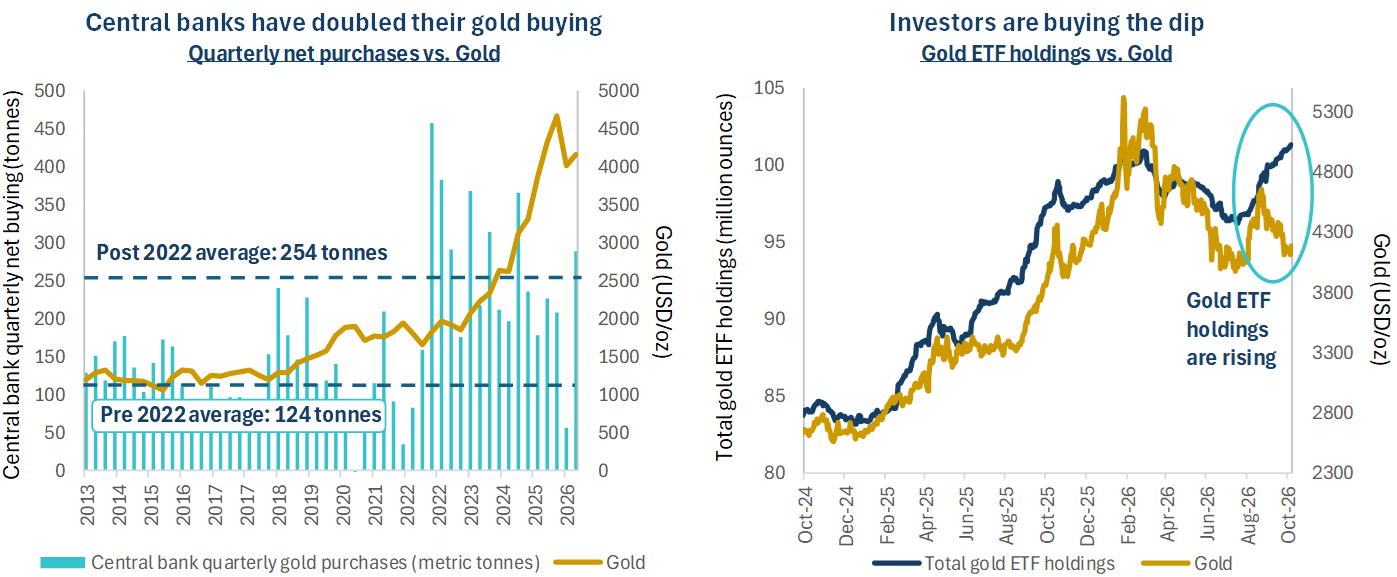
The broadening range of market participants in the precious metals sector reflects the long-term structural demand trends underpinning the sector. Whether as a reserve asset, a portfolio diversifier, an inflation hedge or for long-term wealth protection, gold has seen strong demand in recent years. Recent trends have reinforced this, as central banks and gold ETF investors bought the dip as gold sold off during Q2[ii].
Figure 2
Sources: Bloomberg, World Gold Council. Data at 9th October 2026.
Beginning with central banks, official sector buying has emerged as one of the most powerful forces supporting the gold market. Between 2022 and 2024, official sector purchases exceeded 1,000 tonnes per annum, compared with an average of just under 500 tonnes between 2013 and 2021. Although net buying moderated to 863 tonnes in 2025, as gold prices moved sharply upwards, demand remains exceptionally strong by historical standards. Recent months have seen demand from central banks rise sharply, as gold prices consolidated, with China and Poland emerging as the largest buyers over the summer[iii].
Importantly, central bank demand is fundamentally different from speculative investment flows. Central banks are generally strategic, long-term buyers motivated by reserve diversification, geopolitical considerations and monetary resilience rather than short-term price movements. Gold still represents a relatively modest share of reserves for many emerging market economies, including China. We believe that even an incremental reallocation towards gold is likely to sustain meaningful demand for years.
With regard to investor demand for gold, the broad base of buyers indicates long-term support for the sector. Gold’s appeal has traditionally been its ability to protect purchasing power during inflationary bouts or to thrive during periods of falling real interest rates. Increasingly investors are now recognising its potential role as protection against broader financial instability. As the returns of bonds and equities have increasingly converged in recent years, gold offers an alternative source of diversification that does not depend on the creditworthiness of any sovereign issuer.
Investment flows via gold ETFs have recovered since the profit-taking which followed gold’s record highs in February, with net purchases of over 5 million ounces since mid-July[iv]. The willingness to allocate capital to gold despite elevated real yields supports the argument that its investment case is broadening beyond traditional interest rate considerations. Beyond gold, silver also faces strong demand trends from both investment and industrial drivers, notably solar photovoltaics and hi-tech electronics. This is exacerbated by supply constraints for silver which have resulted in multi-year deficits and the depletion of above-ground stocks.
US Fiscal pressures set the scene for the next phase of the precious metals bull market
The deterioration of the fiscal outlook in the US and many G20 countries presents perhaps the most compelling longer-term argument for gold. Policymakers face shrinking room for manoeuvre as persistently high inflation and loose fiscal policy result in elevated yields on government debt. Higher yields threaten to compound debt servicing costs, while attempts to suppress borrowing costs risks undermining confidence.
Figure 3
Sources: Bloomberg. Data at 9th October 2026.
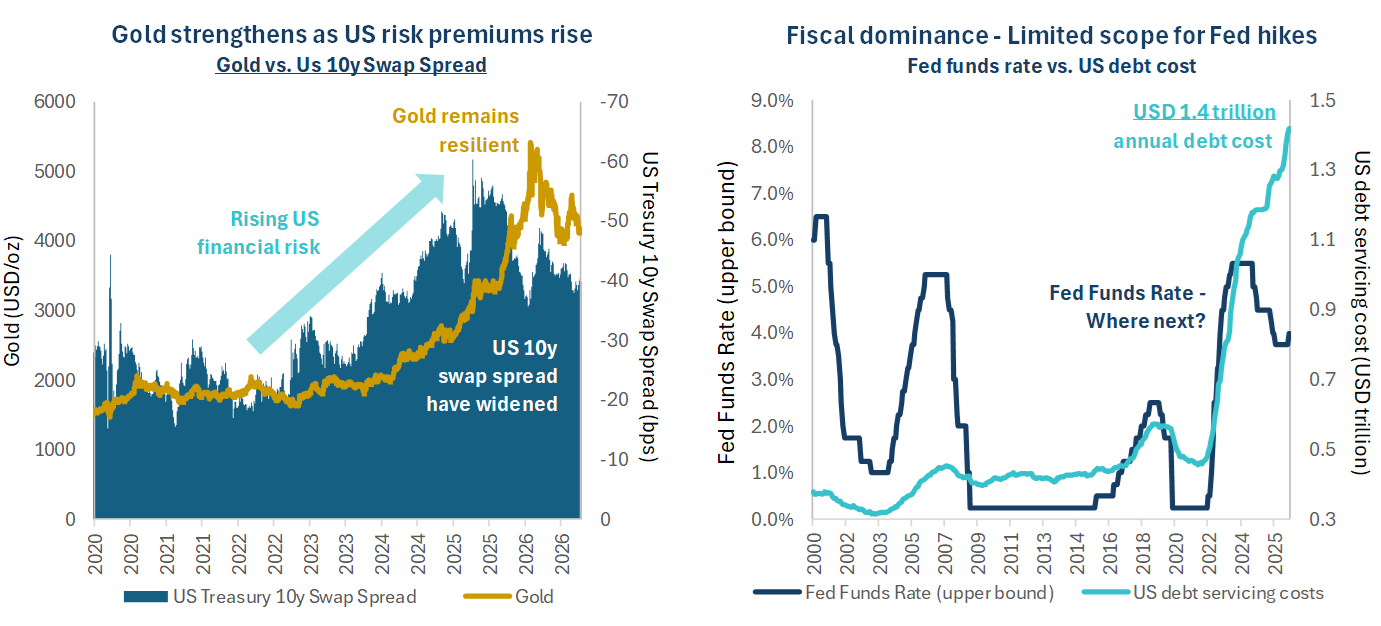
As illustrated on the right-hand chart above, interest payments on US government debt have hit USD 1.4 trillion annually, exceeding the defence budget[v]. With public debt now at 123% of GDP[vi], the debt burden has continued to increase, despite interest rate cuts in recent years. As the US rate outlook has shifted from cuts to hikes in recent months, the implications for the sustainability of US debt are stark. US government net borrowing is on track to hit 8.5% of GDP this year[vii], a level rarely seen outside wartime or deep recessions. The US military involvement in the Middle East is not helping its steep fiscal deficit. Elsewhere, other developed economies are heading for their biggest budget deficits since the Covid-19 crisis.
The unsustainability of the US fiscal position can be seen in the rising risk premium applied to US treasuries by investors. This trend is shown on the left-hand chart above, highlighted by the widening of the US 10y swap spread over the past few years. The ascent of the gold price during this period is no coincidence, gold has provided a hedge against rising US financial risk. Crucially, higher yields are now part of the fiscal problem rather than simply a monetary policy solution. As existing treasuries mature and are refinanced at higher interest rates, the debt servicing cost increases, adding to deficits and requiring further borrowing, creating a potentially self-reinforcing cycle. The growing tension between rising government debt and higher borrowing costs raises the prospect of fiscal dominance, a situation in which monetary policy becomes increasingly constrained by the government’s financing requirements.
Governments facing excessive debt burdens have historically had three broad choices: fiscal consolidation, default or reduction of the real value of their liabilities through inflation. History suggests governments facing excessive debt burdens rarely solve the problem through austerity. A more likely outcome is to maintain nominal interest rates below inflation, resulting in currency debasement and financial repression. This environment would be highly supportive for gold, as investors seek to hold real assets to protect their wealth and purchasing power.
The opportunity in precious metals miners
The Baker Steel team has just returned from two major conferences, the US Gold Forum Americas and Beaver Creek Summit, both held in Colorado, during which over 70 mining company meetings were undertaken. Overall, the sector’s strength is clear, despite the volatility seen in the sector this year. Free cash flow generation continues to be strong, shareholder returns are being prioritised, discipline regarding operating costs and across business strategy more broadly is holding. Growth is emerging as a theme, while M&A discussions among majors continue.
We remain focused on monitoring costs. Operating cost inflation is widely seen as 4-7% annually, with the most significant cost pressures from labour and energy[viii]. Capital cost inflation appears higher, with a wider range of estimates from 5% to 15% annually, with some outliers[ix]. Looking to upcoming results, we anticipate a disparity of outcomes, with many companies expecting a strong Q4, with others likely to disappoint. This reinforces our view that selectivity is key.
Looking ahead, given the long-term backdrop for gold, we believe precious metals miners are well-positioned to outperform the physical metal. Gold is increasingly a hedge against the consequences of excessive debt, geopolitical fragmentation and the potential erosion of monetary credibility. Miners offer operational leverage to precious metals prices, while active management can offer enhanced upside potential as gold prices rise. Periods of rising real yields and dollar strength may continue to generate volatility, we believe the structural forces underpinning demand for precious metals provide the powerful foundation for a sustained bull market.
[i] Reuters, Central Bank of the Russian Federation.
Baker Steel Capital Managers LLP manages three award winning investment strategies, covering precious metals equities, speciality metals equities and diversified mining.
Baker Steel has a strong track record of outperformance relative to its peers and relative to passive investments in the metals and mining sector. BAKERSTEEL Precious Metals Fund is the 2025 winner of the GELD-Magazin Alternative Investment Award, and 2025 winner for the seventh year running of the Lipper Fund Awards while BAKERSTEEL Electrum Fund is the 2025 winner of the Euro Fund Awards Commodity Equities Performance over 10 years. The Baker Steel Resources Trust has also been named Investment Company of the Year 2021, 2020, 2019, Natural Resources, by Investment Week.
Fund Managers Mark Burridge and David Baker have been awarded two Sauren Gold Medals for 2021 and were awarded Fund Manager of the Year at the 2019 Mines & Money Awards.
Important
Please Note: This document is a financial promotion is issued by Baker Steel Capital Managers LLP (a limited liability partnership registered in England, No. OC301191 and authorised and regulated by the Financial Conduct Authority) for the information of a limited number of institutional investors (as defined in the Fund prospectus) on a confidential basis solely for the use of the person to whom it has been addressed. This document does not constitute or form part of any offer to issue or sell, or any solicitation of any offer to subscribe or purchase any shares or any other interests nor shall it or the fact of its distribution form the basis of, or be relied on in connection with, any contract therefor. Recipients of this document who intend to apply for shares or interests in Baker Steel’s funds are reminded that any such application may be made solely on the basis of the information and opinions contained in the relevant prospectus or other offering document relating thereto, which may be different from the information and opinions contained in this document. This report may not be reproduced or provided to any other person and any other person should not rely upon the contents. The distribution of this information does not constitute or form part of any offer to participate in any investment. This report does not purport to give investment advice in any way. Past performance should not be relied upon as an indication of future performance. Future performance may be materially worse than past performance and may cause substantial or total loss.